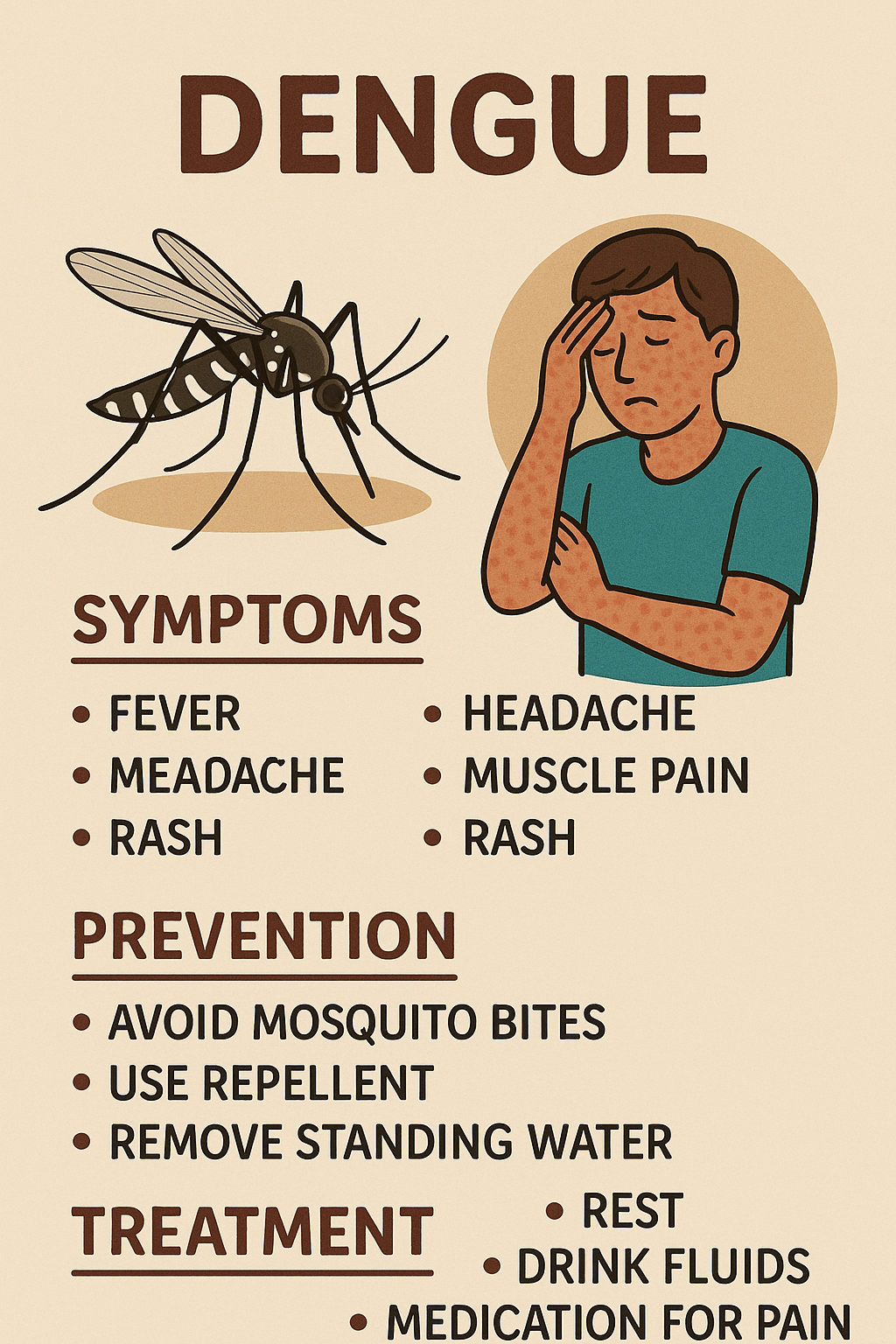
Break bone fever Dengue fever
---
# **DENGUE – DETAILED NOTES (All Concepts Covered)**
**Also called: Break-bone fever**
---
# **1. CAUSATIVE AGENT**
* **Dengue virus (DENV)** – *Flavivirus family*, RNA virus
* **4 serotypes:** DENV-1, DENV-2, DENV-3, DENV-4
* **Infection with one serotype → lifelong immunity only to that serotype**
* **Secondary infection** with different serotype → highest risk of **severe dengue** (DHF/DSS) due to **Antibody-Dependent Enhancement (ADE)**
---
# **2. VECTOR**
* **Aedes aegypti** (primary)
* **Aedes albopictus** (secondary)
**Bites during daytime** (morning + late afternoon)
Breeding sites: clean stagnant water (coolers, buckets, tires, flower pots)
---
# **3. PATHOPHYSIOLOGY**
### **3.1 Viremia Phase**
* Virus infects dendritic cells → spreads to lymph nodes → viremia
* High fever + myalgia
### **3.2 Immune Activation**
* Cytokine storm → ↑ vascular permeability
* Hemoconcentration
* Plasma leakage → pleural effusion, ascites
### **3.3 Antibody-Dependent Enhancement**
* In secondary infection non-neutralizing antibodies enhance viral entry → severe forms (DHF/DSS)
---
# **4. CLINICAL PHASES OF DENGUE (VERY IMPORTANT)**
## **A. FEBRILE PHASE (Day 0–3)**
Symptoms:
* High-grade fever
* Severe myalgia/arthralgia (“break-bone fever”)
* Retro-orbital pain
* Headache
* Flushed skin
* Nausea/vomiting
* Sore throat
* Rash (macular)
Warning signs may **start** here.
## **B. CRITICAL/LEAKAGE PHASE (Day 3–7)**
**Occurs when fever subsides (defervescence)** → dangerous period
Due to **capillary leakage**
Signs:
* Persistent vomiting
* Abdominal pain
* Mucosal bleed
* Hepatomegaly
* Fluid accumulation: pleural effusion, ascites
* Rising hematocrit with falling platelets
* Cold extremities, weak pulse
* Shock = **Dengue Shock Syndrome (DSS)**
## **C. RECOVERY PHASE (Day 7–10)**
* Fluids reabsorb
* Vitals stabilize
* Rash: “white islands in a sea of red” (convalescent rash)
---
# **5. CLASSIFICATION (NEW WHO 2009)**
## **1. Dengue WITHOUT warning signs**
* Fever + 2 of:
* Myalgia
* Rash
* Positive tourniquet test
* Headache
* Leukopenia
* Nausea/vomiting
## **2. Dengue WITH warning signs**
**Important for hospitalization**
* Abdominal pain
* Persistent vomiting
* Mucosal bleed
* Hepatomegaly
* Pleural effusion/ascites
* Lethargy/restlessness
* ↑HCT + ↓Platelets
## **3. Severe Dengue**
* Severe plasma leakage → shock, respiratory distress
* Severe bleeding
* Severe organ impairment:
* Liver: AST/ALT > 1000
* CNS involvement (encephalitis)
* Renal failure
---
# **6. INVESTIGATIONS**
### **Early (Days 1–5)**
* **NS1 Antigen → BEST early test**
* CBC:
* Leukopenia
* Normal platelets initially
### **Later (Day >5)**
* **IgM Dengue Antibody**
* IgG rise (secondary infection)
### **Monitoring during critical phase**
* **Platelets** (falling)
* **Hematocrit (HCT)** (rising) → marker of leakage
* **LFT** – Elevated AST/ALT
* **Ultrasound** – Gall bladder wall edema, pleural effusion, ascites
### **Severe Dengue labs**
* Coagulopathy: ↑PT/INR, ↑aPTT
* Metabolic acidosis
* Organ dysfunction markers (creatinine, transaminases)
---
# **7. MANAGEMENT**
⚠️ **NO NSAIDs / aspirin – risk of bleeding**
Only **Paracetamol** for fever.
## **A. Outpatient Management (No warning signs)**
* ORS / fluids
* Paracetamol
* Daily CBC
* Avoid NSAIDS
* Look for warning signs
## **B. Inpatient Management (With warning signs)**
### **Fluids – Cornerstone of treatment**
* **Isotonic crystalloids (Normal saline or Ringer lactate)**
* Bolus if shock:
**10–20 mL/kg over 15–30 min**
### **Target**
* Maintain urine output > 0.5 mL/kg/hr
* Maintain HCT stable
* Avoid fluid overload
### **Platelet Transfusion**
⚠️ **Do NOT transfuse based on platelet count alone**
Indicated ONLY when:
* Severe bleeding
* Platelet < 10,000 with high risk
* Before surgery/invasive procedure
## **C. Management of Severe Dengue**
* ICU care
* Rapid fluid resuscitation
* Blood transfusion if major bleeding
* Correct metabolic acidosis
* Oxygen
* Treat organ dysfunction
---
# **8. COMPLICATIONS**
* Hepatic failure
* Encephalitis
* Myocarditis
* ARDS
* Multi-organ failure
* Severe bleeding
* DSS (shock)
---
# **9. PREVENTION**
## **Vector Control**
* Remove stagnant water
* Use mosquito nets/repellents
* Wear long sleeves
* Indoor spraying
## **Vaccines**
Two types globally:
* **CYD-TDV (Dengvaxia)** – only for seropositive individuals (>9 years)
* **TAK-003 (QDENGA)** – newer, approved in some countries (India regulatory decisions evolving)
Not widely used for universal primary prevention yet.
---
# **10. HIGH-YIELD POINTS FOR EXAMS**
* **NS1 positive early**, IgM late
* **Secondary infection → severe dengue (ADE)**
* **Warning signs signal critical phase**
* **Rising HCT + falling platelets = Plasma leakage**
* **NO NSAIDs**
* **Fluid therapy = most important treatment**
* **Gallbladder wall edema on USG = marker of severe dengue**
* **Shock occurs at defervescence (when fever drops)**
---
# **11. QUICK DIFFERENTIATION**
### **Dengue vs. Chikungunya**
| Feature | Dengue | Chikungunya |
| ---------- | ------ | ----------------- |
| Platelets | ↓↓↓ | Normal/slightly ↓ |
| Joint pain | Mild | Very severe |
| Rash | Common | Common |
| Shock | Common | Rare |
---