Diarrhea
---
# **DIARRHEA — COMPLETE CLINICAL NOTE**
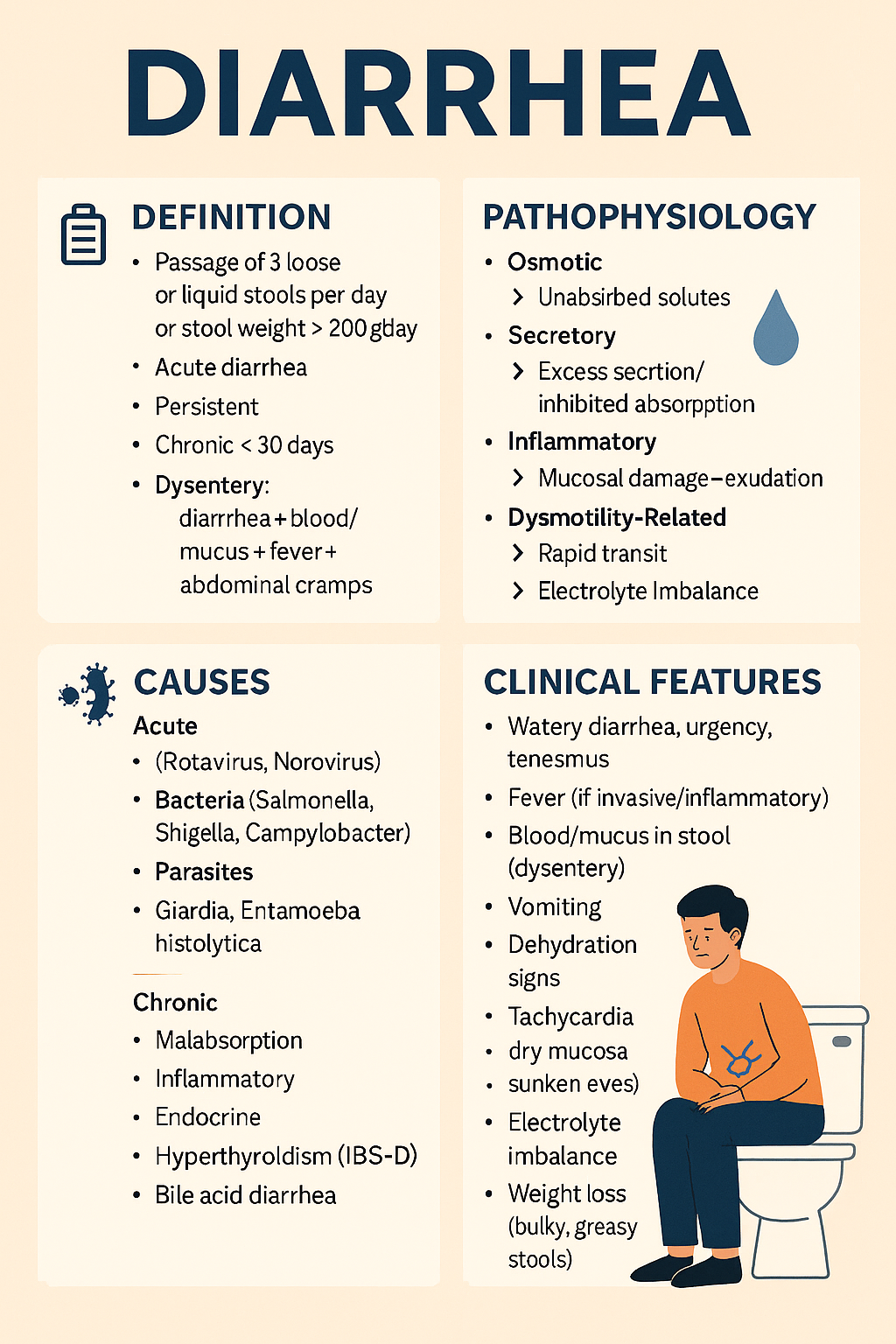
## **1. Definition**
* **Diarrhea =** passage of **≥3 loose/liquid stools per day** OR stool weight **>200 g/day**.
* **Acute diarrhea:** <14 days
* **Persistent:** 14–30 days
* **Chronic:** >30 days
* **Dysentery:** diarrhea + blood/mucus + fever + abdominal cramps (usually Shigella/Entamoeba).
---
## **2. Pathophysiology**
Diarrhea occurs due to one or more mechanisms:
### **1. Osmotic diarrhea**
* Unabsorbed solutes draw water into lumen.
* Stops with fasting.
* Examples: lactose intolerance, sorbitol, magnesium laxatives.
### **2. Secretory diarrhea**
* Excess chloride & water secretion, inhibited absorption.
* Persists despite fasting.
* Examples: cholera, ETEC, VIPoma, bile acid malabsorption.
### **3. Inflammatory diarrhea**
* Mucosal damage → exudation of blood/protein.
* Examples: Shigella, Salmonella, Campylobacter, IBD.
### **4. Dysmotility-related diarrhea**
* Rapid transit → reduced absorption.
* Examples: hyperthyroidism, IBS-D, post-vagotomy.
### **5. Fat malabsorption (steatorrhea)**
* Due to pancreatic insufficiency, celiac disease, Crohn’s.
---
## **3. Causes / Etiology**
### **Acute Diarrhea**
**Infectious (most common):**
* **Viral:** Rotavirus, Norovirus, Adenovirus
* **Bacterial:**
* **Toxin mediated:** S. aureus, Bacillus cereus, C. perfringens
* **Invasive:** Shigella, Salmonella, Campylobacter, EHEC
* **Secretory:** Vibrio cholerae, ETEC
* **Parasitic:** Giardia, Entamoeba histolytica, Cryptosporidium
**Non-infectious:** Drug-induced (antibiotics → C. difficile), laxatives, PPIs, chemotherapy.
---
### **Chronic Diarrhea**
* **Malabsorption:** Celiac disease, tropical sprue, chronic pancreatitis
* **Inflammatory:** UC, Crohn’s
* **Endocrine:** Hyperthyroidism, Addison’s
* **Irritable bowel syndrome (IBS-D)**
* **Post-cholecystectomy bile acid diarrhea**
* **HIV-associated enteropathy**
---
## **4. Clinical Features**
* **Watery diarrhea**, urgency, tenesmus
* **Fever** (if invasive/inflammatory)
* **Blood/mucus in stool** (dysentery)
* **Vomiting** (viral/bacterial toxin)
* **Dehydration signs:** tachycardia, dry mucosa, sunken eyes, poor skin turgor, low urine output
* **Electrolyte imbalance:** hyponatremia, hypokalemia
* **Weight loss** (chronic)
* **Steatorrhea:** bulky, greasy stools (malabsorption)
Red flags:
* Severe dehydration
* Blood in stools
* High fever
* Persistent vomiting
* Age <5 years or elderly
* Immunocompromised patients
---
## **5. Investigations / Diagnosis**
### **Acute diarrhea (usually clinical only)**
* **Stool routine + microscopy** (WBCs → invasive; cysts, ova)
* **Stool culture** (Shigella, Salmonella, Campylobacter)
* **Stool antigen/PCR**: Rotavirus, Norovirus, Giardia, C. difficile toxin
* **Electrolytes, renal function** if dehydrated
* **Blood cultures** if suspected typhoid/sepsis
### **Chronic diarrhea**
* **CBC, ESR/CRP**
* **TSH, cortisol**
* **tTG-IgA for celiac**
* **Stool fat estimation**
* **Fecal calprotectin** (IBD)
* **Colonoscopy with biopsy**
* **Hydrogen breath test** (lactose intolerance)
* **Imaging:** CT abdomen, MR enterography (Crohn’s)
---
## **6. Differential Diagnosis**
* Infectious diarrhea
* Irritable bowel syndrome (IBS-D)
* Celiac disease
* Ulcerative colitis / Crohn’s disease
* Hyperthyroidism
* Lactose intolerance
* Pancreatic insufficiency
* Bile acid diarrhea
* C. difficile colitis
* Medication-induced (antibiotics, metformin, PPIs)
---
## **7. Management**
### **A. General Measures**
1. **Rehydration (MOST IMPORTANT):**
* **ORS (WHO)** – small frequent sips.
* Severe → **IV fluids** (Ringer Lactate).
2. **Continue feeding**, including breastfeeding.
3. **Avoid** fruit juices, sodas, high-sugar drinks.
---
### **B. Antibiotics (ONLY if indicated)**
| Condition | Drug | Dose |
| ----------------------- | ------------- | ---------------------------------------- |
| **Cholera** | Doxycycline | 300 mg single dose |
| **Shigellosis** | Ceftriaxone | 2 g IV daily × 3 days |
| | Azithromycin | 1 g day 1 → 500 mg × 2 days |
| **Traveler’s diarrhea** | Azithromycin | 1 g single dose |
| **Campylobacter** | Azithromycin | 500 mg × 3 days |
| **Giardiasis** | Tinidazole | 2 g single dose |
| **Amebiasis** | Metronidazole | 800 mg TID for 5–10 days + luminal agent |
---
### **C. Antimotility agents**
**Loperamide** (not for blood/mucus stools or fever):
* **Adult:** 4 mg initially → 2 mg after each loose stool (max 16 mg/day).
---
### **D. Probiotics**
* Lactobacillus GG or Saccharomyces boulardii
* Faster recovery in viral diarrhea and antibiotic-associated diarrhea.
---
### **E. Management of specific conditions**
* **Celiac:** Gluten-free diet.
* **IBD:** 5-ASA, steroids, biologics.
* **Pancreatic insufficiency:** Pancreatic enzyme replacement.
* **Bile acid diarrhea:** Cholestyramine.
---
## **8. Drugs (MOA, Dose, AE, CI, Monitoring, Counselling)**
### **1. ORS (Oral Rehydration Solution)**
* **MOA:** Glucose-mediated sodium absorption → water follows.
* **Dose:** As per dehydration status (75 mL/kg over 4 hrs in children).
* **AE:** Rare—vomiting if taken fast.
* **CI:** Severe dehydration → use IV.
* **Monitoring:** Urine output, capillary refill.
* **Counselling:** Small frequent sips; continue feeding.
---
### **2. Loperamide**
* **Indication:** Acute non-invasive diarrhea, IBS-D
* **MOA:** μ-opioid receptor agonist → ↓ motility
* **Dose:** 4 mg → then 2 mg after each stool (max 16 mg/day)
* **AE:** Constipation, abdominal cramps, toxic megacolon
* **CI:** Bloody diarrhea, fever, C. difficile
* **Monitoring:** Hydration, stool pattern
* **Counselling:** Stop if fever/blood develops.
---
### **3. Azithromycin**
* **Indications:** Traveler’s diarrhea, Campylobacter, Shigella
* **MOA:** 50S ribosomal inhibitor
* **Dose:** 1 g single OR 500 mg × 3 days
* **AE:** QT prolongation, GI upset
* **CI:** Macrolide allergy
* **Monitoring:** ECG in cardiac patients
* **Counselling:** Take on empty stomach.
---
### **4. Metronidazole**
* **Indications:** Amebiasis, C. difficile (some regimens), Giardia
* **MOA:** Free radicals damage DNA of anaerobes
* **Dose:** 800 mg TID × 5–10 days
* **AE:** Metallic taste, neuropathy, disulfiram-like reaction
* **CI:** Alcohol use
* **Monitoring:** LFTs if prolonged
* **Counselling:** NO alcohol during & 48 h after treatment.
---
### **5. ORAL Zinc (in children)**
* **Indication:** Pediatric diarrhea
* **MOA:** Enhances mucosal repair
* **Dose:** 20 mg/day × 10–14 days
* **AE:** Nausea
* **Counselling:** Essential for faster recovery.
---
## **9. Complications**
* **Severe dehydration & shock**
* **Electrolyte imbalance** (hypokalemia → arrhythmia)
* **Acute kidney injury**
* **Sepsis** (in invasive infections)
* **Toxic megacolon** (C. difficile, IBD)
* **Malnutrition** in chronic cases
---
## **10. When to Admit**
* Severe dehydration
* Intractable vomiting
* High fever + bloody stools
* Elderly, infants, immunocompromised
* Suspected sepsis or cholera outbreak
---
 ```html