Maternal Pelvis Anatomy Types Measurements and Obstetric Significance
# **Maternal Pelvis Anatomy Types Measurements and Obstetric Significance**
## **Introduction**
The **maternal pelvis** is a rigid bony structure that forms the birth canal. Its **shape, size, and dimensions** are critical determinants of **labor progression, fetal descent, and delivery outcome**. In obstetrics, detailed assessment of the maternal pelvis helps predict **normal vaginal delivery, obstructed labor, and cephalopelvic disproportion**.
---
## **Anatomy of the Maternal Pelvis**
### **1. Bones Forming the Pelvis**
* **Two hip bones** (each formed by ilium, ischium, and pubis)
* **Sacrum**
* **Coccyx**
These bones unite to form a **bony ring** that supports pelvic organs and provides a passage for childbirth.
---
## **Divisions of the Maternal Pelvis**
### **1. False Pelvis (Greater Pelvis)**
* Located above the pelvic brim
* Supports the gravid uterus
* Has **no direct role in labor**
### **2. True Pelvis (Lesser Pelvis)**
* Located below the pelvic brim
* Forms the **birth canal**
* Obstetrically important part
---
## **Pelvic Brim (Inlet)**
The pelvic brim separates the false and true pelvis.
### **Boundaries**
* Sacral promontory (posterior)
* Ala of sacrum
* Linea terminalis
* Upper border of pubic symphysis (anterior)
---
## **Planes and Diameters of the Maternal Pelvis**
### **1. Pelvic Inlet**
**Important diameters**
* **Anteroposterior (Obstetric conjugate)**: ~10.5 cm
* **Transverse diameter**: ~13 cm
* **Oblique diameter**: ~12 cm
**Clinical importance**
* Determines engagement of fetal head
---
### **2. Pelvic Cavity**
* Curved canal with nearly equal AP and transverse diameters
* Smooth lateral walls favor rotation of the fetal head
---
### **3. Pelvic Outlet**
**Boundaries**
* Ischial tuberosities
* Coccyx
* Lower border of pubic arch
**Important diameters**
* **Anteroposterior**: ~11.5 cm (increases during labor due to coccygeal movement)
* **Intertuberous diameter**: ~11 cm
**Clinical importance**
* Determines completion of vaginal delivery
---
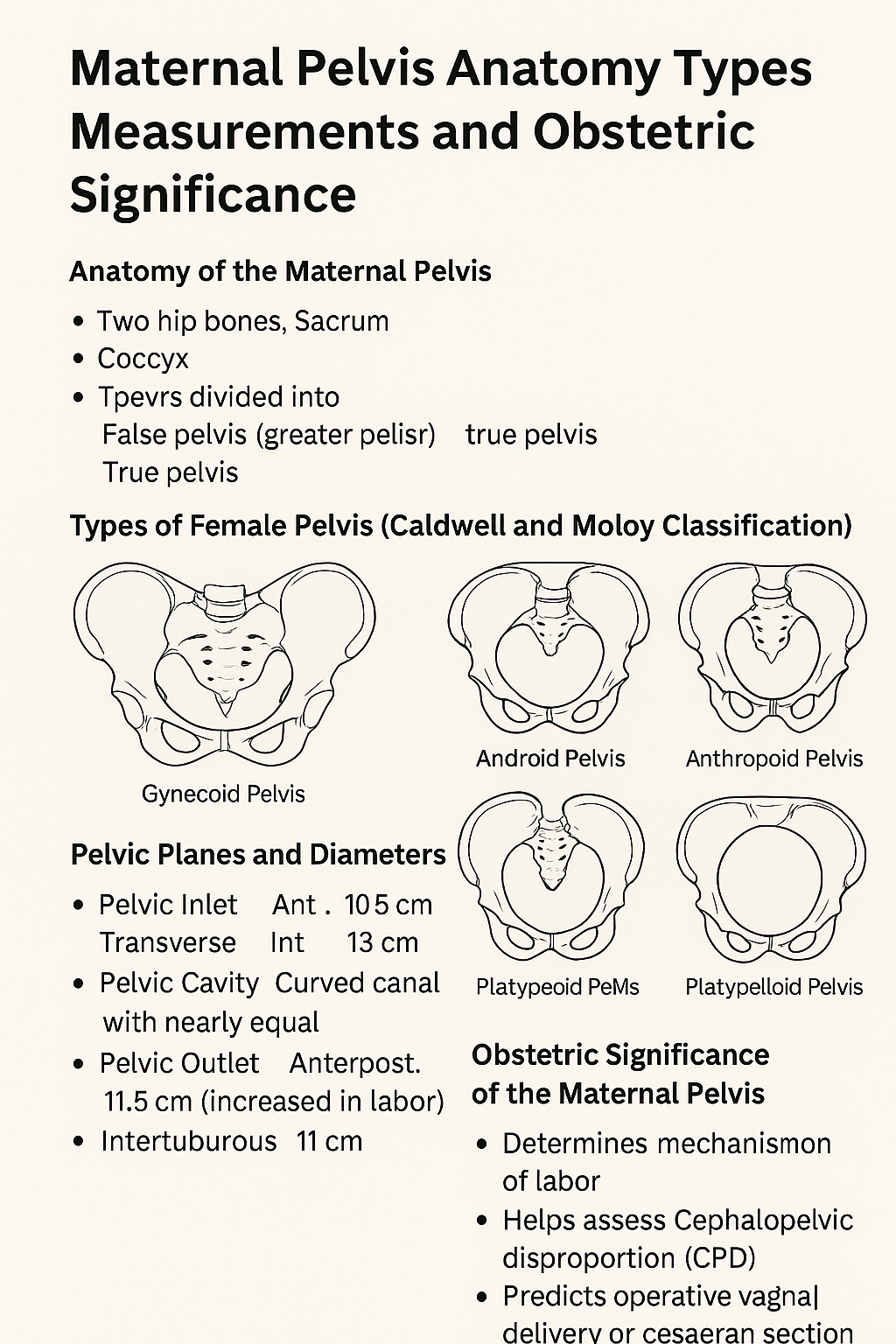
## **Types of Female Pelvis (Caldwell and Moloy Classification)**
### **1. Gynecoid Pelvis**
* Rounded inlet
* Wide subpubic angle
* Straight side walls
**Most favorable for vaginal delivery**
### **2. Android Pelvis**
* Heart-shaped inlet
* Narrow forepelvis
* Prominent ischial spines
**Associated with deep transverse arrest**
### **3. Anthropoid Pelvis**
* Oval inlet with long AP diameter
* Favors occipitoposterior positions
**Vaginal delivery usually possible**
### **4. Platypelloid Pelvis**
* Flattened inlet
* Wide transverse diameter
* Short AP diameter
**Engagement may be difficult**
---
## **Obstetric Significance of the Maternal Pelvis**
* Determines **mechanism of labor**
* Helps assess **cephalopelvic disproportion**
* Predicts **operative vaginal delivery or cesarean section**
* Influences fetal head **engagement, rotation, and descent**
---
## **Clinical Assessment of the Maternal Pelvis**
### **1. Clinical Pelvimetry**
* Performed per vaginum
* Assesses pelvic inlet, cavity, and outlet
### **2. Imaging Pelvimetry**
* X-ray, CT, or MRI pelvimetry
* Reserved for selected cases
---
## **Common Obstetric Problems Related to Pelvis**
* Contracted pelvis
* Obstructed labor
* Prolonged labor
* Fetal malposition and malrotation
---
## **Conclusion**
The **maternal pelvis** plays a decisive role in childbirth. Knowledge of **pelvic anatomy, dimensions, and pelvic types** is essential for safe obstetric practice, early identification of labor complications, and appropriate delivery planning.
---
### **SEO Keywords**
maternal pelvis anatomy, types of female pelvis, obstetric pelvis, pelvic inlet outlet diameters, gynecoid pelvis, android pelvis, anthropoid pelvis, platypelloid pelvis, pelvic planes obstetrics, clinical pelvimetry
If you want, I can **generate 25 hard case-based MCQs in a single HTML CSS JS file**, or **convert this into exam notes or infographic-ready content**.