Postpartum Hemorrhage Clinical Guide Causes Diagnosis Management
## **Postpartum Hemorrhage (PPH): Complete SEO-Optimized Clinical Guide**
### **Definition**
**Postpartum hemorrhage (PPH)** is excessive bleeding following childbirth.
* **Primary (early) PPH:** ≥500 mL blood loss after vaginal delivery or ≥1000 mL after cesarean section within **24 hours** of birth.
* **Secondary (late) PPH:** Abnormal or heavy bleeding occurring **24 hours to 6 weeks postpartum**.
---
## **Epidemiology and Importance**
* One of the **leading causes of maternal mortality worldwide**
* Can occur **without warning**, even in low-risk pregnancies
* Prompt recognition and structured management are lifesaving
---
## **Pathophysiology (Why PPH Occurs)**
After delivery, placental separation exposes uterine blood vessels. Normal hemostasis depends on:
* Effective **uterine contraction**
* Intact **placental removal**
* Normal **coagulation mechanisms**
Failure of any of these leads to hemorrhage.
---
## **Causes of PPH – The 4 Ts**
### **1. Tone (Uterine Atony – most common)**
* Uterus fails to contract effectively
* Causes: prolonged labor, overdistended uterus, grand multiparity, oxytocin overuse
### **2. Trauma**
* Genital tract lacerations (cervix, vagina, perineum)
* Uterine rupture or inversion
### **3. Tissue**
* Retained placental tissue
* Placenta accreta spectrum
### **4. Thrombin**
* Coagulation disorders
* DIC, severe preeclampsia, sepsis
---
## **Risk Factors**
* Previous PPH
* Multiple pregnancy
* Prolonged or precipitate labor
* Instrumental delivery
* Placenta previa or accreta
* Polyhydramnios
* Severe anemia
---
## **Clinical Features**
* Excessive vaginal bleeding
* Boggy or enlarged uterus
* Hypotension, tachycardia
* Pallor, dizziness, altered sensorium
* Reduced urine output (late sign)
---
## **Diagnosis**
Primarily **clinical**
### Supportive Investigations:
* Hemoglobin and hematocrit
* Blood group and cross-match
* Coagulation profile
* Bedside ultrasound (retained tissue)
---
## **Management of PPH (Stepwise and Life-Saving)**
### **Immediate Actions (Golden Hour)**
* Call for help
* Secure **two large-bore IV lines**
* Start crystalloids
* Oxygen via face mask
* Monitor vitals and urine output
---
### **Uterotonic Drugs (First-Line Treatment)**
#### **Oxytocin**
* **Indication:** First-line uterine atony
* **Dose:** 10 IU IM or 20–40 IU IV infusion
* **Mechanism:** Increases uterine smooth muscle contraction
* **Adverse effects:** Hypotension (rapid IV), water intoxication
* **Monitoring:** Uterine tone, blood pressure
#### **Methylergometrine**
* **Dose:** 0.2 mg IM
* **Mechanism:** Sustained uterine contraction
* **Contraindications:** Hypertension, heart disease
* **Adverse effects:** Hypertension, nausea
#### **Carboprost (15-methyl PGF₂α)**
* **Dose:** 250 µg IM every 15 min (max 8 doses)
* **Contraindications:** Asthma
* **Adverse effects:** Bronchospasm, diarrhea
#### **Misoprostol**
* **Dose:** 800–1000 µg per rectal
* **Use:** When injectables unavailable
* **Adverse effects:** Fever, shivering
---
### **Mechanical and Surgical Measures**
* Bimanual uterine massage
* Uterine balloon tamponade (Bakri balloon)
* Uterine artery ligation
* Internal iliac artery ligation
* **Hysterectomy** (last resort, life-saving)
---
### **Blood and Coagulation Management**
* Packed RBC transfusion
* Fresh frozen plasma
* Platelets if thrombocytopenia
* Treat DIC aggressively
---
## **Management of Secondary PPH**
* Antibiotics (endometritis)
* Evacuation of retained products
* Uterotonics
* Surgical intervention if needed
---
## **Prevention of PPH**
### **Active Management of Third Stage of Labor (AMTSL)**
* Prophylactic oxytocin
* Controlled cord traction
* Uterine massage
---
## **Complications**
* Hypovolemic shock
* Acute kidney injury
* Sheehan syndrome
* Maternal death
---
## **Prognosis**
Excellent with **early recognition and structured management**. Delays increase morbidity and mortality.
---
## **Key Takeaways for Exams and Practice**
* **Uterine atony is the most common cause**
* Always follow the **4 Ts approach**
* Treat clinically—do not wait for lab reports
* Hysterectomy is **life-saving, not failure**
---
### **SEO Keywords**
postpartum hemorrhage, PPH management, causes of postpartum hemorrhage, uterine atony, primary PPH, secondary PPH, obstetric emergency, AMTSL, PPH treatment guidelines
If you want, I can also provide:
* **SEO title and meta description**
* **Case-based MCQs**
* **Exam-oriented flowcharts**
* **HTML CSS JS MCQ interface**
* **FAQ schema content for PPH page**
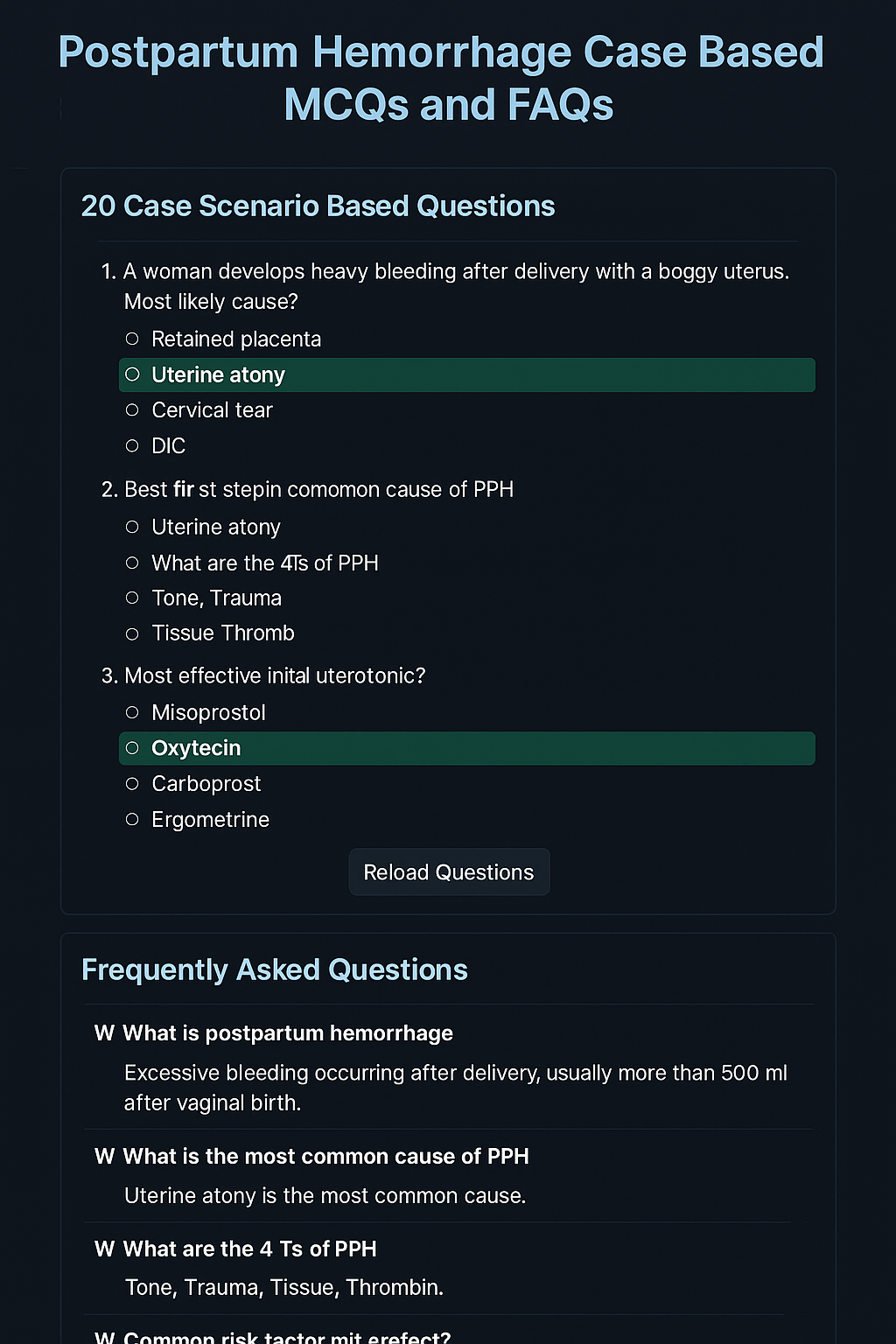
Postpartum Hemorrhage Case Based MCQs and FAQs
20 Case Scenario Based Questions
Frequently Asked Questions
What is postpartum hemorrhage?
Excessive bleeding after delivery, usually more than 500 ml.
Most common cause of PPH?
Uterine atony.
What are the 4 Ts?
Tone, Trauma, Tissue, Thrombin.
First line drug?
Oxytocin.
When is hysterectomy done?
When conservative measures fail.
What is secondary PPH?
Bleeding from 24 hours to 6 weeks postpartum.
Best prevention?
Active management of third stage of labor.
Common risk factor?
Previous PPH.
Side effect of misoprostol?
Fever and shivering.
Why is PPH dangerous?
It can rapidly cause shock and death.