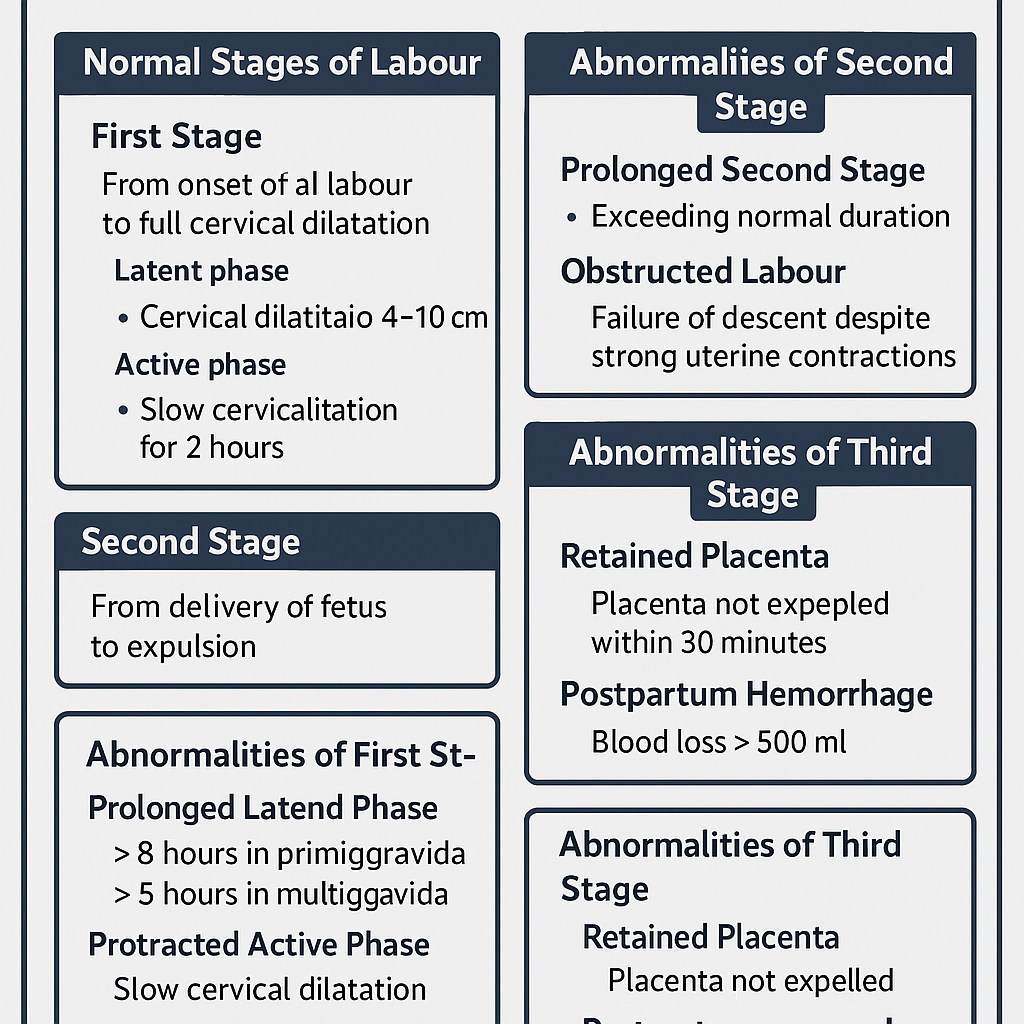
Stages of Labour Normal and Abnormal Progress Complete Clinical Guide
## **Stages of Labour Normal and Abnormal Progress Complete Clinical Guide**
### **SEO Description**
Comprehensive obstetrics guide explaining normal and abnormal stages of labour with mechanisms, duration, clinical features, diagnosis, complications, and management for exams and clinical practice.
### **SEO Keywords**
stages of labour, normal labour stages, abnormal labour, prolonged labour, obstructed labour, dysfunctional labour, first stage labour, second stage labour, third stage labour, active labour management, obstetrics labour guide
---
# **Stages of Labour Normal and Abnormal**
Labour is the **physiological process by which the fetus, placenta, and membranes are expelled from the uterus after fetal viability** through coordinated uterine contractions resulting in cervical effacement and dilatation.
---
## **Classification of Labour**
* **Normal Labour**: Spontaneous onset, singleton, cephalic presentation, term pregnancy, no complications, vaginal delivery.
* **Abnormal Labour**: Any deviation in onset, duration, progress, or outcome of labour.
---
# **Normal Stages of Labour**
## **First Stage of Labour**
**Definition:** Period from onset of true labour pains to full cervical dilatation (10 cm).
### **Phases**
#### **Latent Phase**
* Cervical dilatation: 0–3 cm
* Cervical effacement occurs
* Contractions mild to moderate
* Duration:
* Primigravida: up to 8 hours
* Multigravida: up to 5 hours
#### **Active Phase**
* Cervical dilatation: 4–10 cm
* Rapid dilatation
* Strong, regular contractions
* Rate of dilatation:
* Primigravida: ~1 cm/hour
* Multigravida: ~1.5 cm/hour
### **Normal Mechanism**
* Uterine contractions
* Cervical effacement and dilatation
* Formation of forewaters and bulging membranes
---
## **Second Stage of Labour**
**Definition:** Period from full cervical dilatation to delivery of the fetus.
### **Characteristics**
* Strong expulsive uterine contractions
* Voluntary maternal bearing down
* Fetal descent, flexion, rotation, extension, restitution, expulsion
### **Duration**
* Primigravida: up to 2 hours (3 hours with epidural)
* Multigravida: up to 1 hour (2 hours with epidural)
---
## **Third Stage of Labour**
**Definition:** Period from delivery of fetus to expulsion of placenta and membranes.
### **Mechanism**
* Placental separation
* Placental descent
* Placental expulsion
### **Duration**
* Usually within 5–15 minutes
* Maximum acceptable: 30 minutes
### **Signs of Placental Separation**
* Uterus becomes globular and firm
* Lengthening of umbilical cord
* Sudden gush of blood
* Uterine fundus rises
---
# **Abnormal Labour**
Abnormal labour occurs due to problems related to **powers, passenger, or passage**.
---
## **Abnormalities of First Stage**
### **Prolonged Latent Phase**
* > 8 hours in primigravida
* > 5 hours in multigravida
> **Causes**
* Ineffective uterine contractions
* Anxiety, dehydration
* False labour
**Management**
* Reassurance
* Hydration and analgesia
* Rule out cephalopelvic disproportion
---
### **Protracted Active Phase**
* Slow cervical dilatation
**Causes**
* Uterine inertia
* Malposition
* Mild CPD
**Management**
* Partograph monitoring
* Amniotomy
* Oxytocin augmentation if indicated
---
### **Arrest of Dilatation**
* No cervical dilatation for 2 hours
**Causes**
* Obstructed labour
* Malpresentation
**Management**
* Evaluate cause
* Cesarean delivery if obstruction present
---
## **Abnormalities of Second Stage**
### **Prolonged Second Stage**
* Exceeds normal duration
**Causes**
* Ineffective pushing
* Epidural analgesia
* Fetal malposition
* Pelvic inadequacy
**Complications**
* Maternal exhaustion
* Fetal distress
**Management**
* Assisted vaginal delivery
* Cesarean section if indicated
---
### **Obstructed Labour**
**Definition:** Failure of descent despite strong uterine contractions.
**Causes**
* Cephalopelvic disproportion
* Fetal anomalies
* Pelvic tumors
**Complications**
* Uterine rupture
* Fetal hypoxia
**Management**
* Emergency cesarean section
---
## **Abnormalities of Third Stage**
### **Retained Placenta**
* Placenta not expelled within 30 minutes
**Types**
* Placenta adherens
* Trapped placenta
* Placenta accreta spectrum
**Management**
* Active management
* Manual removal under anesthesia
---
### **Postpartum Hemorrhage**
* Blood loss >500 ml vaginal delivery
**Causes**
* Uterine atony
* Retained placental tissue
**Management**
* Uterotonics
* Bimanual compression
* Surgical intervention if required
---
# **Clinical Monitoring of Labour**
* Partograph use
* Fetal heart rate monitoring
* Maternal vitals
* Progress of cervical dilatation and descent
---
# **Summary Table**
| Stage | Normal Duration | Common Abnormalities |
| ------ | --------------- | ---------------------- |
| First | Latent + Active | Prolonged, Arrest |
| Second | ≤2 hours | Prolonged, Obstructed |
| Third | ≤30 minutes | Retained placenta, PPH |
---
## **Key Exam Pearls**
* Active phase starts at 4 cm dilatation
* Arrest disorders require prompt intervention
* Third stage complications cause most maternal morbidity
* Partograph is essential for early detection of abnormal labour
---
If you want, I can **add MCQs, case based questions, management algorithms, or convert this into an exam-ready PDF or website content**.