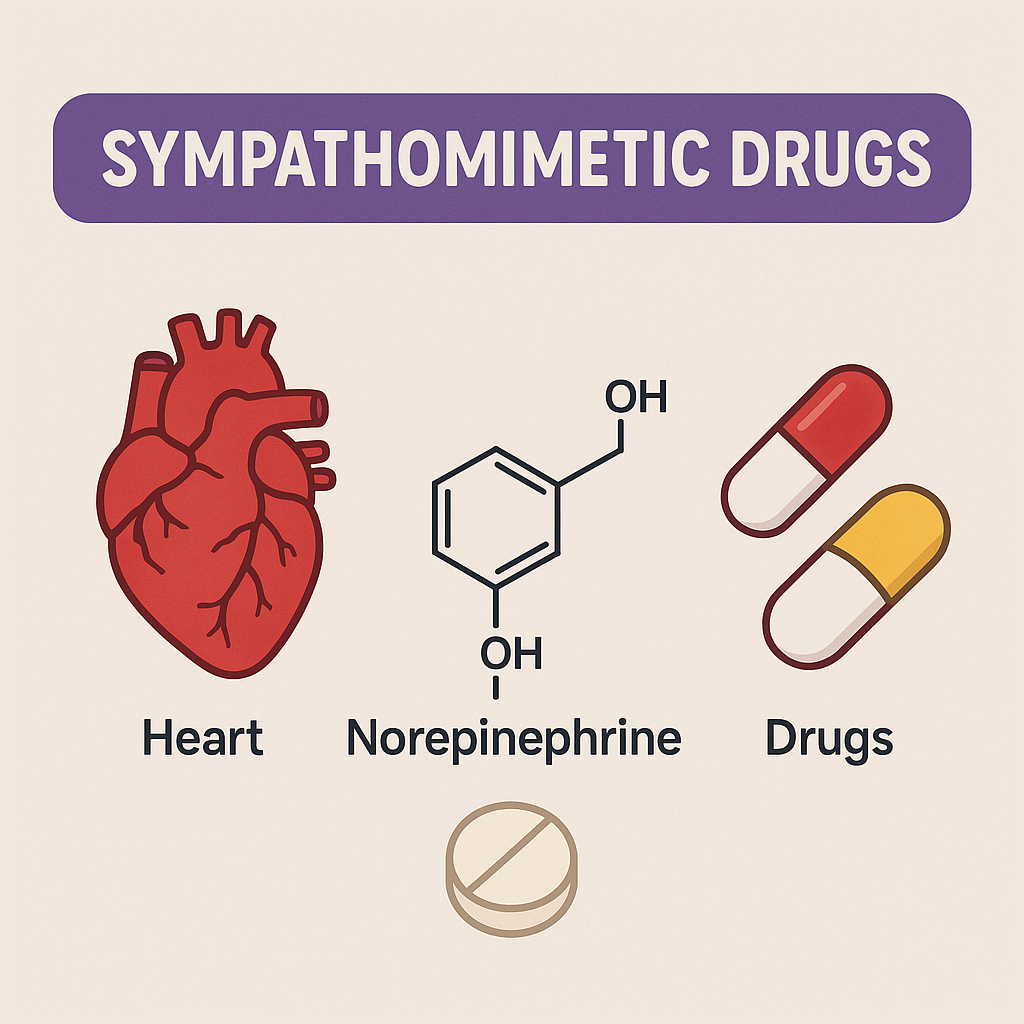
sympathomimetic drugs
---
# ⭐ **Sympathomimetic Drugs — Complete Stylish Note (Ultra-Advanced)**
---
# 🎯 **1. Definition**
**Sympathomimetics** are drugs that **mimic the actions of endogenous catecholamines** (epinephrine, norepinephrine, dopamine) by stimulating **α, β, or dopamine receptors** of the **sympathetic nervous system**.
---
# 🔬 **2. Pathophysiology / Mechanism of Action**
### **A. Direct-acting**
Bind directly to adrenergic receptors:
**α₁ agonists:** vasoconstriction
**α₂ agonists:** ↓ sympathetic outflow → ↓ BP
**β₁ agonists:** ↑ HR, ↑ contractility
**β₂ agonists:** bronchodilation, tocolysis
**Dopamine agonists:** renal vasodilation
### **B. Indirect-acting**
↑ endogenous catecholamines
– Promote NE release → *amphetamine*
– Inhibit reuptake → *cocaine, TCA*
– Inhibit metabolism → *MAO inhibitors & COMT inhibitors*
### **C. Mixed-acting**
– *Ephedrine*: directly stimulates α & β; releases NE
– *Pseudoephedrine*: nasal decongestant
---
# 🧪 **3. Classification of Sympathomimetic Drugs**
---
## 🌟 **A. Direct-Acting Agents**
### **1. α₁ Selective Agonists**
| Drug | Use |
| ----------------- | ----------------------------- |
| **Phenylephrine** | Nasal decongestant, mydriasis |
| **Midodrine** | Orthostatic hypotension |
| **Methoxamine** | Vasopressor |
### **2. α₂ Selective Agonists**
| Drug | Use |
| ------------------- | ---------------------------- |
| **Clonidine** | HTN, ADHD, opioid withdrawal |
| **Methyldopa** | Pregnancy HTN |
| **Dexmedetomidine** | ICU sedation |
| **Tizanidine** | Muscle spasticity |
---
### **3. β₁ Selective Agonists**
| Drug | Use |
| -------------- | -------------------------------- |
| **Dobutamine** | Acute heart failure, stress test |
| **Xamoterol** | Partial β₁ agonist |
---
### **4. β₂ Selective Agonists**
**Short-acting (SABA):**
– **Salbutamol**, **Terbutaline**
**Long-acting (LABA):**
– **Salmeterol**, **Formoterol**
**Ultra-long:**
– **Indacaterol**, **Olodaterol**
**Uses:**
Bronchodilation, tocolysis
---
### **5. Mixed α + β Agonists**
| Drug | Receptor | Use |
| ------------------ | ----------- | --------------------------- |
| **Epinephrine** | α₁ α₂ β₁ β₂ | Anaphylaxis, cardiac arrest |
| **Norepinephrine** | α₁ α₂ β₁ | Septic shock |
| **Isoproterenol** | β₁ β₂ | Torsades, AV block |
---
### **6. Dopamine Receptor Agonists**
| Dose | Effect |
| --------- | ----------------------- |
| Low dose | Renal vasodilation (D₁) |
| Moderate | ↑ cardiac output (β₁) |
| High dose | Vasoconstriction (α₁) |
---
# 🚨 **4. Pharmacokinetics (PK) Essentials**
* Catecholamines **short half-life**, metabolized by **MAO & COMT**
* Non-catecholamines (ephedrine, amphetamine) **longer acting**, CNS penetration
* Most require IV for acute indications
* Renal & hepatic clearance varies widely
---
# 🎭 **5. Clinical Effects (Organ-wise)**
## **Heart**
* β₁ → ↑ HR, ↑ contractility
* α₁ → ↑ afterload (vasoconstriction)
## **Lungs**
* β₂ → bronchodilation, ↓ mast cell degranulation
## **Eye**
* α₁ → mydriasis
* β₂ → ↓ aqueous humor
## **Uterus**
* β₂ → tocolysis
## **Metabolic**
* β₂ → ↑ glycogenolysis, ↑ lipolysis
* β₁ → ↑ renin
---
# 🧠 **6. Indications (With First-Line Drugs)**
### ✔ **Shock**
* **Septic shock:** Norepinephrine
* **Cardiogenic:** Dobutamine
* **Anaphylaxis:** Epinephrine
* **Neurogenic shock:** Phenylephrine
### ✔ **Asthma**
* SABA: Salbutamol
* Status asthmaticus: Nebulized salbutamol ± ipratropium
### ✔ **Preterm Labor**
* Terbutaline
### ✔ **Nasal Decongestion**
* Phenylephrine
* Xylometazoline
* Oxymetazoline
### ✔ **Glaucoma**
* Brimonidine (α₂)
### ✔ **Hypertension**
* Clonidine
* Methyldopa (pregnancy)
---
# ⚠️ **7. Adverse Effects (Drug-wise)**
## **α₁ Agonists**
* Hypertension
* Headache
* Ischemia
* Urinary retention
## **α₂ Agonists**
* Sedation
* Rebound HTN (clonidine withdrawal)
## **β₁ Agonists**
* Tachycardia
* Arrhythmias
* Palpitations
## **β₂ Agonists**
* Tremor
* Hypokalemia
* Hyperglycemia
* Tachycardia
## **Dopamine Agonists**
* Arrhythmias
* Gangrene (high-dose α₁ vasoconstriction)
---
# ⛔ **8. Contraindications**
* Hyperthyroidism (↑ sensitivity)
* Severe CAD
* Pheochromocytoma
* MAOI use (risk of hypertensive crisis)
---
# 🔥 **9. Drug–Drug Interactions**
* **MAOI + sympathomimetics → hypertensive crisis**
* **TCAs → exaggerated pressor response**
* **β-blockers block β agonists → unopposed α (dangerous)**
* **Cocaine + epinephrine → severe HTN, arrhythmia**
---
# 📊 **10. Monitoring**
* HR, BP, ECG
* Serum potassium for β₂ agonists
* Blood glucose
* Urine output (shock)
* Peripheral perfusion (vasopressors)
---
# 🎓 **11. High-Yield NEETPG Points**
🔥 Epinephrine is the **drug of choice for anaphylaxis**
🔥 Norepinephrine is **first-line for septic shock**
🔥 Clonidine withdrawal → **rebound hypertension**
🔥 Salbutamol → **hypokalemia**
🔥 α₂ agonists → **↓ sympathetic outflow**
🔥 Isoproterenol → widest pulse pressure
🔥 Dopamine dose-dependent receptor effect = exam favorite
---
# 📝 **12. Quick Comparison Table**
| Drug | Receptors | Major Use |
| -------------- | ----------- | ------------------------- |
| Epinephrine | α₁ α₂ β₁ β₂ | Anaphylaxis |
| Norepinephrine | α₁ α₂ β₁ | Septic shock |
| Dobutamine | β₁ | Cardiogenic shock |
| Salbutamol | β₂ | Asthma |
| Phenylephrine | α₁ | Hypotension, decongestion |
| Clonidine | α₂ | HTN, withdrawal |
| Dopamine | D₁ β₁ α₁ | Shock (dose-dependent) |
---
# 🌈 **13. Beautiful Last-Minute Revision Mnemonics**
### **Sympathomimetic Receptors: “A1 = Arteries, B1 = Beats, B2 = Bronchi + Baby (uterus)”**
### **α₂ effects: “2 things ↓ — BP ↓ & Sympathetic ↓”**
### **Dopamine: “D-B-A” (Dose-based receptors)**
* **D** — Low dose
* **B** — β₁
* **A** — α₁ high dose
---
---
## 🩺 Case 1 – Anaphylactic Shock After Bee Sting (Epinephrine IM)
**Scenario:**
24-year-old man, sudden breathlessness, wheeze, urticaria, BP 70/40, HR 130, after bee sting.
**Key Diagnosis:** Anaphylactic shock.
**Drug & Dose (Adult):**
* **Epinephrine 0.3–0.5 mg IM** (0.3–0.5 mL of 1:1000) in anterolateral thigh.
* Repeat every **5–15 min** as needed.
**Management Algorithm:**
1. **Airway:** High-flow O₂, prepare for intubation if stridor/impending arrest.
2. **Epinephrine IM** immediately (do NOT delay for IV access).
3. **IV access + fluids:** Rapid 1–2 L isotonic crystalloid bolus.
4. **Adjuncts:**
* H1 blocker: Chlorpheniramine IV
* H2 blocker: Ranitidine IV (optional)
* Steroid: Hydrocortisone 200 mg IV
5. **Bronchospasm:** Add **nebulized salbutamol** if wheeze persists.
6. **Observe** at least **4–6 h** (longer for severe cases/biphasic reactions).
**Adverse Effects & Monitoring (Epinephrine):**
* Tachycardia, arrhythmias, hypertension, tremor, anxiety.
* Monitor: ECG, BP, HR, O₂ saturation, urine output.
---
## 🩺 Case 2 – Septic Shock (Norepinephrine Infusion)
**Scenario:**
65-year-old with pneumonia, hypotension (80/50) despite 30 mL/kg fluids, lactate ↑, cold peripheries.
**Key Diagnosis:** Septic shock.
**Drug & Dose:**
* **Norepinephrine IV infusion**: start **0.05–0.1 mcg/kg/min**, titrate to maintain MAP ≥ 65 mmHg.
**Management Algorithm:**
1. **Initial resuscitation:**
* High-flow O₂
* 30 mL/kg crystalloid in first 3 hours
2. **Start norepinephrine via central line** (preferably) with infusion pump.
3. **Titrate dose** every 5–10 min to MAP ≥ 65.
4. Add **vasopressin** or **epinephrine** if refractory (not first-line detail, but concept).
5. Start **broad-spectrum antibiotics within 1 hour**, source control.
6. Monitor: lactate, urine output, organ function.
**Adverse Effects & Monitoring (Norepinephrine):**
* Peripheral ischemia, arrhythmias, hypertension.
* Watch for **extravasation** (risk of tissue necrosis), continuous BP & ECG monitoring.
---
## 🩺 Case 3 – Cardiogenic Shock Post-MI (Dobutamine)
**Scenario:**
58-year-old man post-anterior MI, BP 85/55, cool extremities, reduced urine output, pulmonary congestion.
**Key Diagnosis:** Cardiogenic shock.
**Drug & Dose:**
* **Dobutamine IV infusion**: **2–20 mcg/kg/min**, titrate to effect.
**Management Algorithm:**
1. O₂, monitor ECG, BP, urine output.
2. Treat underlying MI (antiplatelets, anticoagulation, reperfusion if possible).
3. Start **dobutamine** for low cardiac output with adequate BP.
4. Adjust rate to improve perfusion (urine output, mentation, BP).
5. Avoid excessive tachycardia; consider adding vasopressor if BP too low.
**Adverse Effects & Monitoring:**
* Tachycardia, arrhythmias, angina, hypotension (if vasodilation predominates).
* Continuous ECG, BP, signs of ischemia.
---
## 🩺 Case 4 – Low Output + Renal Hypoperfusion (Dopamine)
**Scenario:**
72-year-old in mixed septic–cardiogenic shock, oliguria (urine < 0.3 mL/kg/h), MAP borderline.
**Key Diagnosis:** Shock with renal hypoperfusion.
**Drug & Dose:**
* **Dopamine IV infusion**
* **2–5 mcg/kg/min** → dopaminergic (renal vasodilation)
* **5–10 mcg/kg/min** → β₁ (↑CO)
* **>10 mcg/kg/min** → α₁ (vasoconstriction)
**Management Algorithm:**
1. Fluid resuscitation first.
2. Start dopamine at **2–5 mcg/kg/min**, titrate based on BP & urine output.
3. Avoid prolonged high doses (risk of ischemia).
4. Reassess repeatedly; if not effective, switch to norepinephrine/dobutamine per protocol.
**Adverse Effects & Monitoring:**
* Tachyarrhythmias, myocardial ischemia, peripheral ischemia, nausea.
* Monitor ECG, BP, limbs, urine output.
---
## 🩺 Case 5 – Status Asthmaticus (High-Dose Salbutamol)
**Scenario:**
20-year-old with asthma, severe dyspnea, RR 34, SpO₂ 88%, cannot complete sentences, use of accessory muscles.
**Key Diagnosis:** Severe acute asthma exacerbation.
**Drug & Dose:**
* **Salbutamol nebulization 2.5–5 mg** every **20 min for first hour**, then as needed.
**Management Algorithm:**
1. O₂ to keep SpO₂ ≥ 94%.
2. **Nebulized salbutamol** + **ipratropium**.
3. IV steroids: e.g., Methylprednisolone 40–80 mg IV.
4. If no response: consider IV MgSO₄, possible ICU/intubation.
5. Avoid sedatives.
**Adverse Effects & Monitoring (Salbutamol):**
* Tremor, tachycardia, palpitations, **hypokalemia**, hyperglycemia.
* Monitor HR, BP, serum K⁺ if frequent dosing.
---
## 🩺 Case 6 – Preterm Labor (Terbutaline)
**Scenario:**
28-year-old at 31 weeks gestation, regular contractions, cervix 2 cm, intact membranes.
**Key Diagnosis:** Threatened preterm labor.
**Drug & Dose:**
* **Terbutaline 0.25 mg SC**, can repeat every **20–30 min** up to **3 doses**, then infusion if used per protocol.
**Management Algorithm:**
1. Confirm preterm labor (exclude infection, abruption, fetal distress).
2. Give **terbutaline** SC (tocolysis) if no contraindications (e.g., severe preeclampsia).
3. Administer **antenatal corticosteroids** for lung maturity.
4. Monitor maternal HR, BP, glucose, fetal heart rate.
5. Avoid prolonged β₂ agonist use in high-risk cardiac patients.
**Adverse Effects & Monitoring:**
* Maternal tachycardia, tremor, hyperglycemia, **pulmonary edema**, hypotension.
* Fetal tachycardia.
* Strict fluid balance and vitals monitoring.
---
## 🩺 Case 7 – Chronic Asthma Control (LABA + ICS)
**Scenario:**
35-year-old with daily asthma symptoms, uses SABA > 3×/week, nocturnal symptoms.
**Key Diagnosis:** Moderate persistent asthma.
**Drug & Dose (LABA part):**
* **Salmeterol 50 mcg inhaled BID** (always with inhaled corticosteroid).
**Management Algorithm:**
1. Confirm diagnosis (spirometry).
2. Step-up therapy: **ICS + LABA combo inhaler**.
3. Educate on inhaler technique, adherence, trigger avoidance.
4. Review after 4–6 weeks, adjust step up/down.
**Adverse Effects (LABA):**
* Tremor, palpitations, headache, rarely paradoxical bronchospasm.
* Do **not** use LABA without ICS in asthma (↑ mortality risk).
---
## 🩺 Case 8 – Mild Intermittent Asthma (Rescue SABA)
**Scenario:**
19-year-old with exercise-induced wheeze, rare symptoms.
**Key Diagnosis:** Mild intermittent asthma.
**Drug & Dose:**
* **Salbutamol 100–200 mcg (1–2 puffs)** via MDI **as needed**, or before exercise.
**Management Algorithm:**
1. Provide reliever SABA inhaler.
2. Educate: use spacer, pre-exercise prophylaxis.
3. Avoid overuse (>2 days/week → step up).
**Adverse Effects & Monitoring:**
* Tremor, tachycardia; monitor usage frequency (marker of poor control).
---
## 🩺 Case 9 – Nasal Congestion (Topical α₁ Agonist)
**Scenario:**
30-year-old with acute viral rhinitis, severe nasal congestion.
**Key Diagnosis:** Acute nasal congestion.
**Drug & Dose:**
* **Xylometazoline or Oxymetazoline 0.05%** – 1–2 sprays per nostril **every 8–12 h**, max **3–5 days**.
**Management Algorithm:**
1. Short-term topical α agonist for symptomatic relief.
2. Saline irrigation, hydration, steam inhalation.
3. Emphasize duration limit to avoid rebound congestion.
**Adverse Effects & Monitoring:**
* Local irritation, dryness, **rebound congestion (rhinitis medicamentosa)** if >5–7 days.
* Rare systemic hypertension, tachycardia (if absorbed).
---
## 🩺 Case 10 – Orthostatic Hypotension (Midodrine)
**Scenario:**
65-year-old with diabetic autonomic neuropathy, dizziness on standing, BP drop > 20 mmHg systolic.
**Key Diagnosis:** Neurogenic orthostatic hypotension.
**Drug & Dose:**
* **Midodrine 2.5–10 mg PO, 2–3 times/day** (avoid close to bedtime).
**Management Algorithm:**
1. Non-pharmacologic: slow position change, compression stockings, salt & fluid optimization.
2. Start low-dose midodrine, titrate to symptom control.
3. Avoid dose within 4 hours of sleep (risk of supine HTN).
**Adverse Effects & Monitoring:**
* Supine hypertension, piloerection, pruritus, urinary retention.
* Monitor supine vs standing BP, urinary symptoms.
---
## 🩺 Case 11 – ICU Sedation & Sympathetic Control (Dexmedetomidine)
**Scenario:**
Intubated ICU patient with agitation, tachycardia, high sympathetic tone.
**Key Diagnosis:** Need for light sedation with sympathetic dampening.
**Drug & Dose:**
* **Dexmedetomidine IV infusion 0.2–0.7 mcg/kg/h**, usually **without bolus**.
**Management Algorithm:**
1. Start continuous infusion, titrate to sedation scale target (e.g., RASS –1 to 0).
2. Reduce other sedatives/opioids as tolerated.
3. Avoid bolus in unstable patients (risk of brady/hypotension).
**Adverse Effects & Monitoring:**
* Bradycardia, hypotension, dry mouth.
* Continuous BP & HR monitoring.
---
## 🩺 Case 12 – Hypertensive Urgency Managed with Clonidine
**Scenario:**
45-year-old with BP 200/110, headache, but no acute organ damage.
**Key Diagnosis:** Hypertensive urgency.
**Drug & Dose:**
* **Clonidine 0.1–0.2 mg PO** initially, then **0.1 mg hourly** up to total **0.6–0.7 mg** (as per protocol).
**Management Algorithm:**
1. Rule out hypertensive emergency (neuro deficits, chest pain, AKI).
2. If urgency: use **oral clonidine** in monitored setting.
3. Gradual BP reduction over 24–48 h.
4. Start/adjust long-term antihypertensives.
5. Avoid abrupt cessation: taper dose.
**Adverse Effects & Monitoring:**
* Sedation, dry mouth, bradycardia, constipation.
* **Rebound hypertension** with abrupt withdrawal.
* Monitor BP, HR, mental status.
---
## 🩺 Case 13 – Pregnancy-Induced Hypertension (Methyldopa)
**Scenario:**
28-year-old, 30 weeks pregnant, BP 150/98, no proteinuria.
**Key Diagnosis:** Gestational hypertension.
**Drug & Dose:**
* **Methyldopa 250 mg PO 2–3 times/day**, titrate (max ~3 g/day).
**Management Algorithm:**
1. Confirm diagnosis, assess for preeclampsia.
2. Start methyldopa, titrate based on BP response.
3. Regular follow-up BP, fetal growth monitoring.
4. Consider switching postpartum.
**Adverse Effects & Monitoring:**
* Sedation, depression, dry mouth, hepatic dysfunction, hemolytic anemia (rare).
* Monitor LFTs, CBC if long-term.
---
## 🩺 Case 14 – Resistant HTN on Multiple Drugs (Clonidine Add-On)
**Scenario:**
60-year-old with HTN on ACEI + CCB + diuretic, still BP 170/100.
**Key Diagnosis:** Resistant hypertension.
**Drug & Dose:**
* **Clonidine 0.1 mg PO BID**, titrate.
**Management Algorithm:**
1. Confirm adherence, rule out secondary causes.
2. Add centrally acting α₂ agonist (clonidine) as fourth-line.
3. Educate about not stopping abruptly.
4. Regular BP, HR monitoring.
**Adverse Effects & Monitoring:**
* Sedation, dry mouth, bradycardia, **rebound HTN**.
* Monitor mood (risk of depression).
---
## 🩺 Case 15 – AV Block with Bradycardia (Isoproterenol)
**Scenario:**
50-year-old with symptomatic second-degree AV block, HR 30, dizziness, hypotension, awaiting pacemaker.
**Key Diagnosis:** Symptomatic bradycardia / AV block.
**Drug & Dose:**
* **Isoproterenol IV infusion 2–10 mcg/min**, titrate to HR and BP.
**Management Algorithm:**
1. Atropine if appropriate; if ineffective and pacing not immediately available → **isoproterenol**.
2. Continuous ECG & BP monitoring.
3. Use as **bridge to pacemaker** implantation.
**Adverse Effects & Monitoring:**
* Tachyarrhythmias, angina, hypotension (due to β₂ vasodilation).
* Avoid in ischemic heart disease if possible.
---
## 🩺 Case 16 – Torsades de Pointes with Bradycardia (Isoproterenol)
**Scenario:**
Patient with long QT syndrome, recurrent polymorphic VT (torsades), bradycardia.
**Key Diagnosis:** Torsades requiring HR acceleration.
**Drug & Dose:**
* **Isoproterenol IV 2–10 mcg/min** to increase HR and shorten QT.
**Management Algorithm:**
1. Correct hypokalemia, hypomagnesemia (MgSO₄ IV).
2. Discontinue QT-prolonging drugs.
3. If bradycardia-induced torsades: **isoproterenol** or temporary pacing.
4. Continuous ECG monitoring.
**Adverse Effects & Monitoring:**
* Same as Case 15.
---
## 🩺 Case 17 – Open-Angle Glaucoma (Brimonidine)
**Scenario:**
55-year-old with open-angle glaucoma, requires add-on to prostaglandin analog.
**Key Diagnosis:** Chronic glaucoma.
**Drug & Dose:**
* **Brimonidine 0.1–0.2% eye drops**, 1 drop **TID**.
**Management Algorithm:**
1. Continue baseline prostaglandin analog.
2. Add brimonidine to reduce aqueous humor production and ↑ uveoscleral outflow.
3. Regular IOP checks, optic nerve monitoring.
**Adverse Effects & Monitoring:**
* Ocular allergy, conjunctival hyperemia, dry mouth, fatigue.
* Avoid in infants (risk of apnea, CNS depression).
---
## 🩺 Case 18 – Acute Hypotension During Spinal Anesthesia (Phenylephrine)
**Scenario:**
Woman undergoing C-section under spinal, BP drops to 70/40, HR 90.
**Key Diagnosis:** Spinal-induced hypotension.
**Drug & Dose:**
* **Phenylephrine 50–100 mcg IV bolus**, may repeat; or infusion 0.25–1 mcg/kg/min.
**Management Algorithm:**
1. Left uterine displacement, O₂, check airway & breathing.
2. Rapid IV fluid bolus.
3. Give IV phenylephrine bolus; repeat if needed or start infusion.
4. Continuous BP, HR, fetal monitoring.
**Adverse Effects & Monitoring:**
* Reflex bradycardia, hypertension, decreased uterine blood flow (if excessive).
* Monitor BP, HR closely.
---
## 🩺 Case 19 – Cardiac Stress Test (Dobutamine Stress Echo)
**Scenario:**
Patient cannot exercise on treadmill, needs ischemia evaluation.
**Key Diagnosis:** Need for pharmacologic stress.
**Drug & Dose:**
* **Dobutamine IV**: incremental doses (e.g., 5 → 10 → 20 → 30–40 mcg/kg/min) in stages.
**Management Algorithm:**
1. Baseline ECG, echo, vitals.
2. Start dobutamine; increase dose every 3 min while monitoring.
3. Stop if: target HR achieved, ischemia on ECG/echo, severe symptoms/arrhythmia.
**Adverse Effects & Monitoring:**
* Tachycardia, arrhythmias, angina.
* Continuous ECG, BP, symptoms.
---
## 🩺 Case 20 – β₂ Agonist Overuse (Salbutamol Toxicity)
**Scenario:**
Asthmatic patient using salbutamol inhaler >15–20 puffs/day, palpitations, tremor, muscle cramps.
**Key Diagnosis:** β₂ agonist overuse → toxicity.
**Management Algorithm (No specific antidote, but supportive):**
1. Reduce SABA use, step up controller (ICS ± LABA).
2. Check **serum potassium** and correct hypokalemia.
3. Monitor HR, BP, ECG for arrhythmia.
**Adverse Effects & Monitoring:**
* Tremor, tachycardia, palpitations, hypokalemia, hyperglycemia.
---
## 🩺 Case 21 – Clonidine Withdrawal Rebound Hypertension
**Scenario:**
Patient on clonidine for HTN abruptly stops; BP 220/120, severe headache.
**Key Diagnosis:** Rebound hypertensive crisis.
**Management Algorithm:**
1. Restart clonidine or give short-acting antihypertensive (e.g., labetalol), as per protocol.
2. Avoid rapid BP drop; gradually control.
3. Educate patient on tapering.
**Adverse Effects:**
* Severe rebound HTN, headache, agitation, tachycardia.
* Monitor BP & neuro status closely.
---
## 🩺 Case 22 – ADHD Child (Dexmethylphenidate vs Sympathomimetics Context)
*(Not a classic peripheral sympathomimetic like epi/NE, but central stimulant with sympathomimetic actions.)*
**Scenario:**
8-year-old with ADHD, poor school performance.
**Drug (conceptual):** Central stimulant with indirect sympathomimetic activity.
**Key Points (Exam Concept):**
* Increases NE/DA in CNS.
* AE: ↓ appetite, insomnia, tachycardia, ↑ BP.
*(Detailing dose skipped here since it moves beyond classic adrenergic agonist list.)*
---
## 🩺 Case 23 – Decongestant Overuse (Rhinitis Medicamentosa)
**Scenario:**
Man using oxymetazoline drops for 4 weeks, now severe constant congestion.
**Key Diagnosis:** Rhinitis medicamentosa.
**Management Algorithm:**
1. Gradually withdraw topical decongestant.
2. Switch to **intranasal steroids + saline**.
3. Educate: future use ≤3–5 days.
**Adverse Effects (Topical α agonists):**
* Chronic mucosal edema, rebound congestion, rarely systemic HTN/Tachy.
---
## 🩺 Case 24 – Obstructive Sleep Apnea with Daytime BP Spikes (Sympathetic Overactivity)
**Scenario:**
OSA patient with early morning hypertension, tachycardia.
**Key Concept:** Chronic **sympathetic overdrive**, not directly treated with sympathomimetic but relevant pathophysiology.
**Management:**
* Treat OSA (CPAP), weight loss, BP control.
* Avoid unnecessary sympathomimetics at night.
---
## 🩺 Case 25 – Epinephrine in Cardiac Arrest (ACLS)
**Scenario:**
Adult in pulseless VT/VF.
**Drug & Dose:**
* **Epinephrine 1 mg IV** (1:10,000) every **3–5 min** during CPR.
**Management Algorithm (ACLS core):**
1. High-quality CPR, defibrillation as indicated.
2. Epinephrine IV/IO q3–5 min.
3. Treat reversible causes (H’s & T’s).
**Adverse Effects:**
* Not a concern during arrest, but post-ROSC: hypertension, tachyarrhythmia.
---
## 🩺 Case 26 – Epinephrine for Severe Croup (Nebulized)
**Scenario:**
Child with severe stridor, barking cough, chest retractions.
**Drug & Dose:**
* **Nebulized racemic epinephrine** (exact dose per preparation; concept: α-induced mucosal vasoconstriction).
**Algorithm:**
1. Keep child calm, O₂ if needed.
2. Nebulized epinephrine + systemic steroids.
3. Observe for rebound obstruction.
**Adverse Effects:**
* Tachycardia, hypertension, agitation; monitor HR & resp status.
---
## 🩺 Case 27 – Emergency Bronchodilation in Hyperkalemia (Salbutamol)
**Scenario:**
Patient with CKD, K⁺ 6.8, ECG changes (peaked T waves).
**Drug & Dose:**
* **Nebulized Salbutamol 10–20 mg** over ~10–20 min (high-dose, off-label concept).
**Algorithm:**
1. IV calcium gluconate (membrane stabilization).
2. IV insulin + dextrose.
3. **High-dose salbutamol** to drive K⁺ into cells.
4. Consider dialysis.
**Adverse Effects:**
* Tachycardia, tremor, lactic acidosis; monitor ECG, K⁺.
---
## 🩺 Case 28 – Emergency Hypotension in Anesthesia (Epinephrine Mini-Dose)
**Scenario:**
Intra-operative sudden hypotension, suspected anaphylactoid reaction.
**Drug & Dose:**
* **Epinephrine 10–50 mcg IV bolus** (titrated) in monitored OR setting.
**Algorithm:**
1. Stop suspected trigger, 100% O₂.
2. Give titrated IV epinephrine boluses.
3. Fluids, adjuncts (H1/H2 blocker, steroid).
**Adverse Effects:**
* Arrhythmias, severe hypertension if overdosed.
---
## 🩺 Case 29 – Off-Label Use of Phenylephrine for Priapism (Conceptual)
**Scenario:**
Ischemic priapism >4 h.
**Drug & Dose:**
* **Phenylephrine 100–500 mcg** diluted and injected intracavernosally by specialist.
**Algorithm:**
1. Analgesia, aspiration of blood from corpora.
2. Intracavernosal phenylephrine at intervals.
**Adverse Effects:**
* Hypertension, reflex bradycardia, arrhythmias.
* Monitor BP & HR continuously.
---
## 🩺 Case 30 – Toxic Sympathomimetic Syndrome (Amphetamine/Cocaine)
**Scenario:**
Young man with agitation, sweating, tachycardia, hypertension, dilated pupils after stimulant use.
**Key Concept:** **Sympathomimetic toxidrome.**
**Management Algorithm (No more sympathomimetics!):**
1. Sedate with **benzodiazepines** (NOT β-blocker alone in cocaine).
2. Control BP with vasodilators (e.g., nitroprusside) as per protocol.
3. Cool patient, correct metabolic derangements.
**Adverse Effects (Drugs themselves):**
* Hyperthermia, arrhythmias, MI, stroke, rhabdomyolysis.
---
---
# ⭐ **Side Effects of Sympathomimimetic Drugs — Complete Stylish Reference**
---
# 🔵 **1. α₁-Agonists (Phenylephrine, Midodrine, Methoxamine)**
### **Major Side Effects**
* **Hypertension**
* **Reflex bradycardia**
* **Headache**
* **Anxiety / restlessness**
* **Urinary retention** (due to bladder sphincter contraction)
* **Piloerection (“gooseflesh”)**
* **Ischemia:**
– Peripheral ischemia
– Reduced organ perfusion with high doses
### **Specific Notes**
* **Phenylephrine:**
→ Severe vasoconstriction → risk of ischemia in digits
* **Midodrine:**
→ **Supine hypertension** (major) → *must avoid dosing close to bedtime*
---
# 🔵 **2. α₂-Agonists (Clonidine, Methyldopa, Dexmedetomidine, Tizanidine)**
### **Major Side Effects**
* **Sedation** (very common)
* **Dry mouth**
* **Bradycardia**
* **Hypotension**
* **Dizziness**
### **Special Case Effects**
* **Rebound hypertension** if clonidine stopped abruptly
* **Methyldopa:**
– Hemolytic anemia (Coombs-positive)
– Hepatotoxicity
– Depression
– Hyperprolactinemia
* **Dexmedetomidine:**
– Severe **bradycardia**
– Hypotension
– Sinus arrest (rare)
---
# 🔵 **3. β₁-Agonists (Dobutamine, Xamoterol)**
### **Major Side Effects**
* **Tachycardia**
* **Arrhythmias (PVCs, AF)**
* **Angina / myocardial ischemia**
* **Hypertension**
* **Headache**
### **Notes**
* Dobutamine can precipitate **dangerous tachyarrhythmias** especially in ischemic heart disease.
---
# 🔵 **4. β₂-Agonists (Salbutamol, Terbutaline, Formoterol, Salmeterol)**
### **Major Side Effects**
* **Tremor** (most common)
* **Tachycardia & palpitations**
* **Hypokalemia** (β₂-mediated K⁺ shift into cells)
* **Hyperglycemia**
* **Lactic acidosis** at high doses
* **Headache**
* **Anxiety, insomnia**
* **Muscle cramps**
### **Special Notes**
* **Terbutaline** (tocolysis):
– Maternal **pulmonary edema**
– Maternal tachycardia
– Fetal tachycardia
* **LABAs (Salmeterol, Formoterol):**
– Increased asthma mortality if **used without ICS**
---
# 🔵 **5. Mixed α + β Agonists**
---
## **A. Epinephrine**
### **Side Effects**
* **Tachycardia**
* **Arrhythmias (VT/VF)**
* **Hypertension**
* **Tremors**
* **Anxiety, restlessness**
* **Headache**
* **Hyperglycemia**
* **Local tissue necrosis** (if extravasated IV)
---
## **B. Norepinephrine**
### **Side Effects**
* **Severe peripheral ischemia** (“NE fingers”)
* **Digital necrosis in worst cases**
* **Hypertension**
* **Reflex bradycardia**
* **Arrhythmias**
* **Extravasation → necrosis**
---
## **C. Isoproterenol**
### **Side Effects**
* **Severe tachycardia**
* **Wide pulse pressure** (β₂ vasodilation + β₁ tachycardia)
* **Arrhythmias**
* **Hypotension** (due to vasodilation)
* **Angina** in ischemic heart disease
---
# 🔵 **6. Dopamine (Dose-Dependent Side Effects)**
### **Low–medium doses (2–10 mcg/kg/min):**
* Tachycardia
* Arrhythmias
* Nausea
* Vasodilation → hypotension (in some)
### **High dose (>10 mcg/kg/min):**
* **Severe vasoconstriction**
* **Limb ischemia / gangrene**
* **Hypertension**
* **Cold peripheries**
### **General:**
* Anxiety
* Headache
* Palpitations
---
# 🔵 **7. Indirect-Acting Sympathomimetics (Amphetamine, Cocaine, Pseudoephedrine)**
## **Amphetamine / Methamphetamine**
* Euphoria → psychosis
* Hypertension
* Tachycardia
* Arrhythmias
* Seizures
* Hyperthermia
* Rhabdomyolysis
* Paranoia, agitation
* Stroke / MI risk
---
## **Cocaine**
* **Severe hypertension**
* **Coronary vasospasm → MI**
* **Arrhythmias**
* **Seizures**
* **Hyperthermia**
* **Agitation, paranoia**
⚠️ *NEVER give a pure β-blocker in cocaine toxicity* → unopposed α → severe hypertension.
---
## **Pseudoephedrine / Ephedrine**
* Insomnia
* Nervousness
* Palpitations
* Hypertension
* Tremor
* Urinary retention
* Risk of abuse (mild CNS stimulant)
---
# 🔵 **8. Dopamine Agonists (Dopamine, Fenoldopam)**
### **Fenoldopam**
* Hypotension
* Tachycardia
* Headache
* Flushing
* Increased intraocular pressure (avoid in glaucoma)
---
# 🔵 **9. Ophthalmic Sympathomimetics (Brimonidine, Apraclonidine)**
### **Brimonidine**
* Ocular redness, irritation
* Allergic conjunctivitis
* Dry mouth
* Fatigue
* Drowsiness
* Hypotension (rare systemic absorption)
### **Apraclonidine**
* Tachyphylaxis
* Eyelid retraction
* Mydriasis
* Ocular allergy
---
# 🔥 **10. High-Yield Exam Pointers (Must Remember)**
### ⭐ Epinephrine IM is **first-line for anaphylaxis** — side effect risk is acceptable.
### ⭐ Norepinephrine → **digital ischemia** (important for septic shock MCQs).
### ⭐ Salbutamol → **hypokalemia + tremor**.
### ⭐ Clonidine → **rebound hypertension** if stopped abruptly.
### ⭐ Terbutaline → **maternal pulmonary edema**.
### ⭐ Methyldopa → **hemolytic anemia**, **hepatotoxicity**.
### ⭐ Isoproterenol → **wide pulse pressure + tachycardia**.
### ⭐ Dopamine high-dose → **gangrene**.
---
 ```html
Sympathomimetic Drugs – MCQ Bank 30 case-based · hard
NEET-PG / USMLE-style vignettes covering receptor selectivity, indications, toxicity, and contraindications of adrenergic agonists.